

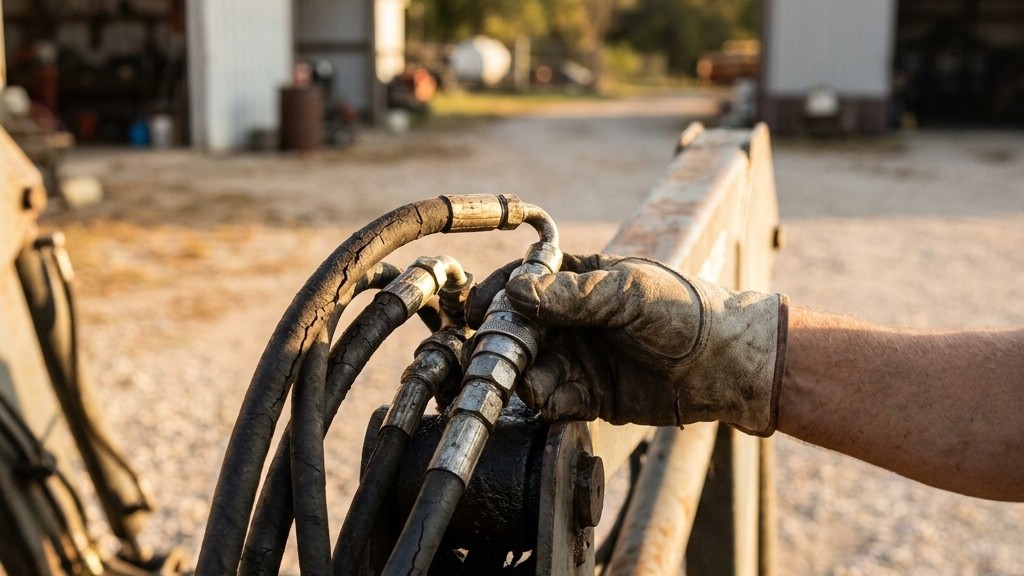
Hydraulic problems announce themselves as weak lift, slow cycles, groaning pumps, or a function that just quits. Some of that is a ten-minute fix you can do in the yard. Some of it is a pump giving up. Here's how to tell which one you've got, in the order that actually finds the problem.
Three things to check first
- Fluid level and condition. Low fluid is the number one cause of weak hydraulics, and it's free to check. While you're at the dipstick, read the fluid itself: milky means water got in, dark and burnt-smelling means heat has been working on it, and glitter in the fluid means something metal is wearing out and you should stop running it.
- Quick couplers. If an attachment function died right after a hookup, pop the couplers loose and re-seat them. One that didn't fully latch blocks flow completely and acts exactly like a dead circuit. It fools people every season because everything else still works.
- The filter. A plugged hydraulic filter starves the whole system. If you don't know when it was last changed, that's your answer. Some machines have a filter restriction indicator that nobody looks at until the loader gets slow.
What the sounds mean
A healthy hydraulic system is mostly quiet. A high whine that rises with engine speed usually points at the pump pulling air, which traces back to low fluid, a loose suction fitting, or a cracked suction line. A groan or shudder when a cylinder reaches the end of its stroke is normal for a second; constant groaning under light load is not. Chattering at the relief valve when you're not asking for full power means the relief is set wrong or sticking.
SHOP NOTE
The five-dollar suction leak is the one that eats pumps. A pump that runs on an air-fluid mix cavitates, and cavitation chews the pump internals slowly enough that the machine "works fine" right up until it doesn't. If the fluid looks foamy on the dipstick after running, chase the suction side now, not at rebuild time.
When it's past the yard fix
Whining or growling from the pump, functions that fade as the machine warms up, cylinders that drift under load, or fluid that keeps disappearing with no puddle to show for it all point at wear inside the system. Warm-fade in particular is the classic sign of internal leakage: cold, thick fluid seals the worn clearances, then warms up, thins out, and slips past them. That's diagnostic work, and it's where pressure testing tells the truth faster than parts swapping ever will. A gauge on the right port answers in ten minutes what three guessed-at parts can't answer in a month.
We do mechanical and hydraulic repair in the shop and on site, on most ag and construction makes. Call and describe what it's doing cold versus warm and loaded versus empty - those two answers usually name the suspect before the van ever rolls.
TRUE COUNTRY EQUIPMENT
Machine acting up? We fix them in the shop and in the field.